I published a pamphlet of Nanci Lee’s poem “Palindrome” last Boxing Day, marking the beginning of Opaat Press. Opaat was an idea that had been lingering in the back of my mind for over a year. I wanted to focus on the poem, as in one poem at a time, whether that be a newsletter that offered close readings, an online journal featuring one poem per “issue,” a zine, or a podcast. It was Nanci’s poem that brought clarity on what I really wanted to do: start a micropress that would put out pamphlets of individual poems.

“Palindrome” is a poem about the ongoing genocide in Palestine. Nanci had showed it to me at my apartment, at the tail end of a holiday party my partner and I had organized. For the past year or so, I’d been organizing the occasional gathering of poets in my living room, often inviting my guests to show up with a poem—their own or someone else’s, or one of each.
I hadn’t asked Nanci to do so that night, but something about the pre-existing ritual might have laid the groundwork for her, or me, that night, as well as for the focus of the publishing project that followed. I’m grateful Nanci brought me “Palindrome,” a poem that has stayed with me since, the poem that inspired me to try the pamphlet form. The urgency of “Palindrome,” the way it seized me, made me want to celebrate and show it to others—and here, I imagined a concrete, physical gesture, literally handing out the poem so it would find new readers. I printed six copies of a prototype and surprised Nanci by leaving them in her mailbox. When she wrote to tell me she liked them, I made the formal offer to publish and distribute the work in a limited run of 50 copies. That set the model for what was to come, and the resulting project has been one of the most rewarding and surprising endeavors I’ve taken on in years.
*
I have some pet theories about different forms of art, particularly poetry. Recently, my friend (and Opaat Press season 4 poet) Cory Lavender and I did a reading together on the South Shore. After the reading, Cory told me about a woman who had come up to him, complaining about her sales as a novelist. Cory was somewhat (rightly) annoyed, as poets’ sales tend to be even more modest than those of novelists or other writers. At one point, he said something like, “There’s more of an audience for novels than for poetry.”
This may well be true, but honestly, I don’t think so. I told Cory that I actually think there is a wider audience for poetry generally—though not necessarily for books of poetry. Overall, novels sell better than books of poetry, but I think there are many fans of poetry who engage with the form in other ways—I think of poems featured on public transit, poems quoted in books and television, poems shared on social media (like the #TodaysPoem trend, which I’ve participated in frequently over the years), and poems expressly written for social media (e.g., Instagram or Twitter poetry). If you recommend a book to a person, they may or may not read it, but show them a one-page poem? They’re likely to look at it on the spot. Even many of the avid poetry readers I know, even many of the poets I know, will focus in on one poem at a time—dipping in and out of collections to re-read standout pieces, copying out and memorizing their favourites.
A book-length collection of poetry might be a hard sell for some audiences. But the individual poem can have wider appeal, a shorter and more digestible form of literature, one that, if the poem is good, opens almost endlessly upon re-reading. Not that it’s just about the “sale” of the thing—a pamphlet of one striking poem allows the piece to shine on its own, giving it the space and consideration it deserves.
When I started Opaat, I hoped to find an affordable and accessible way to distribute poetry, to encourage in particular that intimate act of taking time with a single poem.
*
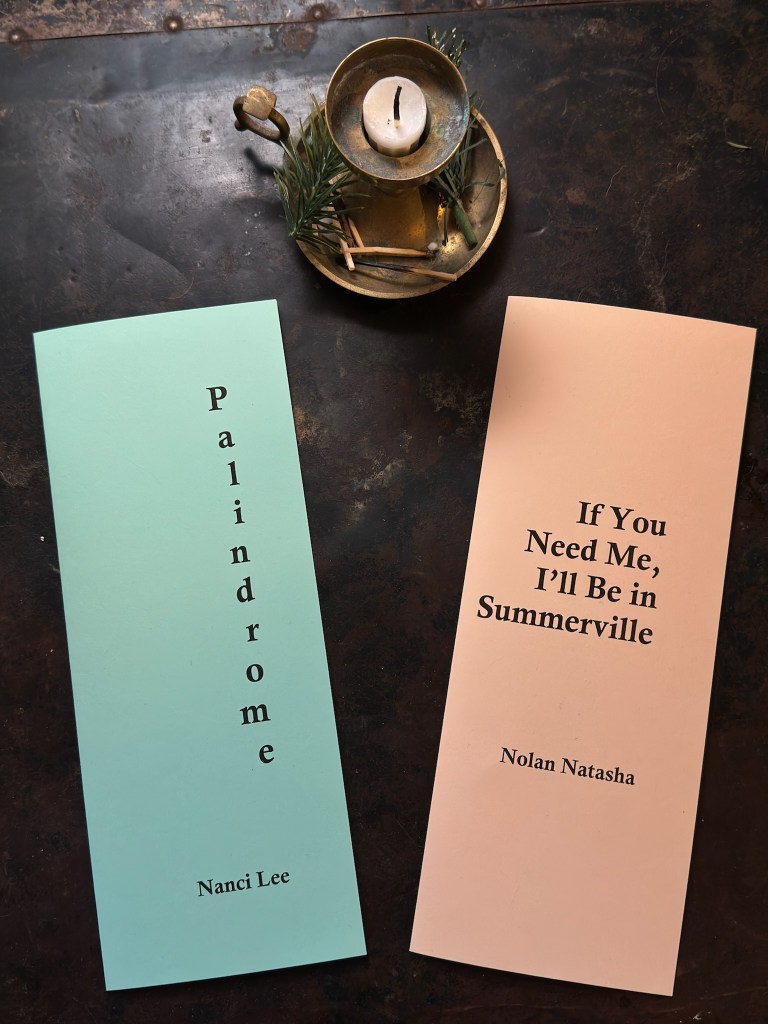
I started with Nanci’s piece. From there, I filled out my first season with other poets in my vicinity—all Kjipuktuk/Halifax-based ones. With the second season, I slowly expanded to other parts of Nova Scotia. In the third and fourth, I reached out to poets from the other Maritime provinces. In the most recent season, I included a poem by a poet currently based in Newfoundland.

Over the course of the year, I published twenty-four pamphlets across five seasons. 1200 copies. Hundreds of envelopes. Enough stamps to arouse the suspicion of local cashiers. Countless trips to Staples.

All pamphlets are currently out of print, with copies having gone out to addresses across the country, as well as the US. In addition to author copies, I’ve managed to pay poets an honorarium for their work, a modest amount (though better than what some university-backed lit journals offer) that will go up next year. I was able to pay many of those same poets to read at online Zoom events, offered free to attendees. Each season, I gave away a few handfuls of pamphlets as a way of promoting the poets and the press, and of ensuring that money wasn’t a complete barrier to readership. At the end of it all, the press isn’t making me rich, but I haven’t lost any money. More importantly, I get to work with writers I admire while providing them with a bit of cash.

Highlights from the first year of the press include the pamphlet I published of Sue Goyette’s poem, “Memorializing Meagher Park on Your Way Home,” getting mentioned in an article in The Coast, and later by then-NDP leader Gary Burrill in the Nova Scotia legislature, as part of a larger discussion about homelessness. Proceeds from those sales were donated to Out of the Cold, while the money made from the pamphlet of my translation of Sappho 16 was donated to the Rainbow Refugee Association of Nova Scotia. Cory read his Opaat pamphlet and gave the press a shout-out during an event in my hometown, London, Ontario. And thanks to the interest and support of Martin Chandler, Liaison Librarian at Cape Breton University, CBU Library now carries most of the Opaat Press pamphlets in its collections.

Certainly, there were challenges as well. In the good-news-bad-news department, several poets have reached out to me to see about my submissions process, and while I’m flattered, I’m not open to submissions, and don’t plan on that changing any time soon. Similarly, I’ve been asked if I’d try bigger runs, as all pamphlets have sold out so quickly. I don’t plan on changing that, either.
In both cases, I’m concerned with sustainability. I’m currently on a full-time teaching contract, with a new book of my own published just a couple months ago. I do all this work on myself, and while I enjoy the independence and freedom this one-woman operation offers, I don’t want to set myself up for too much work or expense. By welcoming material strictly on an invite-only basis and by keeping print runs to 50 copies per pamphlet, I better my chances of being able to do this work consistently and for a longer period.
This fall, I was reminded of the fragility of even very modest publishing projects, like this micropress. First, the postal strike had me stumped as to how to get the pamphlets out, as I’d been relying on the relatively low costs of mailing out pamphlets with Canada Post. Because of this question mark looming in my head, I eagerly accepted an invitation to a local craft fair—only to sell few copies and lose about a third of my stock when water was accidentally spilled on the pamphlets. I was able to recover quickly, thanks in part to the assistance of my partner (and Opaat Press poet) Nolan Natasha, who helped me pick up more paper and set to folding some eighty or so pamphlets (proving himself, in the process, to be much more adept at using a bone folder than I—he’ll surely be recruited for more folding in future seasons)—still, the experience left me more aware of the costs and risks I could face in the future.

Not to mention the incredible strain each season puts on my home printer-photocopier, the poor beaut forced to print on at least 250 (more often 300 or so because of experimenting/mistakes) sheets (double-sided!) of cardstock per season. I was holding my breath while printing this December, and will have to put a line in the budget to get it serviced soon…
*
In the grand scheme of things, these are small challenges, and the experience of running Opaat has been overwhelmingly positive. Most of the poets I’ve reached out to about working on a pamphlet have said yes (a thrill when a legend you’ve read for years says they want to work with you), and it’s rewarding to be able to give their fine words a new audience and a new form. I could never have done this without Nanci, Nolan, Jaime, Sue, Anna, Tiffany, Ben, Alison, Sam, Travis, Chris, Luke, Sappho, Rebecca, Margo, Fawn, Cory, Katie, Jimmy, Laurelyn, Triny, Matt, Sadie, and Sylvia. And obviously, there would be no press without readers—thanks to everyone who bought one (or many!) pamphlets, gifted them, or shared them around. Thanks to those who posted photos of the pamphlets on social media, pinned them to their walls, or found another way to expand their reach.
While I see this micropress as a form of service to the wider literary community, perhaps a new project to replace (at least temporarily) my work as a reviewer and interviewer, it wouldn’t work for me if I didn’t find it meaningful and fun. And I do. Besides promoting poetry to a wider audience (I hope), the press has also allowed me the chance to pursue some of my most-favourite activities—reading poems, chatting with fellow poets, experimenting with design, shopping for colourful cardstock, using my bone folder, addressing envelopes, and walking down the street to the mailbox.
See you in 2025.
 Annick MacAskill